Solar battery storage has moved from a niche technology for the most committed renewable energy enthusiasts to a genuinely mainstream consideration for NSW homeowners who have solar panels installed or who are planning a new solar installation. As battery costs have fallen significantly over the past five years and as feed-in tariff rates have declined — reducing the value of exporting excess solar generation to the grid — the economic case for storing solar energy for self-consumption rather than exporting it has improved substantially for many households. Understanding how battery storage actually works helps homeowners assess whether it makes sense for their specific situation and what to look for in a system.
How solar batteries charge and discharge
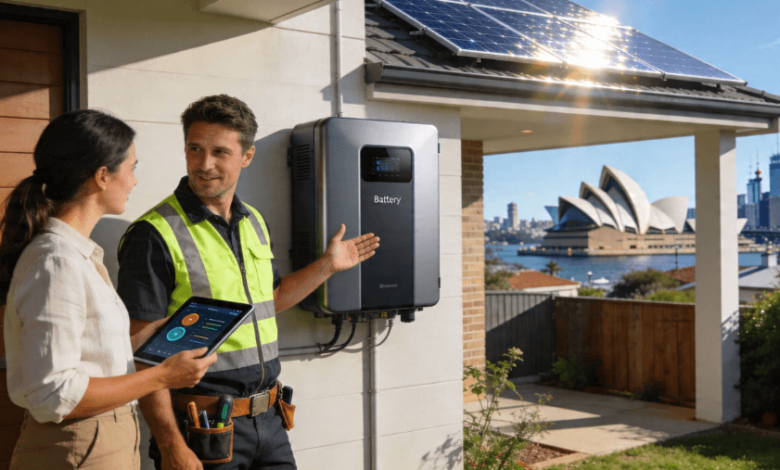
A solar battery system connects to the household’s solar inverter and electrical system and operates on a simple principle: when the solar panels generate more electricity than the household is currently consuming, the excess energy charges the battery rather than being exported to the grid. When the solar panels are not generating — at night, during extended cloudy periods, or when consumption exceeds generation — the battery discharges, supplying the stored electricity to the household and reducing the amount of electricity drawn from the grid. The net effect is that more of the household’s solar energy is consumed within the home rather than being exported at the grid’s feed-in rate, improving the effective return on the solar investment.
Understanding the technical details of solar energy storage NSW systems, including how different battery chemistries, inverter types, and system configurations perform in practice under real Australian conditions, helps homeowners make better decisions about what type of system to install, what capacity to choose, and what performance to expect from their investment. A reputable solar installer will provide clear information about the expected charge and discharge cycles, the battery’s warranted cycle life, the performance degradation over time, and the monitoring capabilities that allow the homeowner to track the system’s operation and verify that it is performing as expected throughout its operational life.
The most common battery chemistry used in residential solar storage systems in Australia is lithium-ion, with lithium iron phosphate (LFP) chemistry increasingly popular for its combination of safety characteristics, long cycle life, and stable performance across a wide range of temperatures. Older lead-acid battery technologies are still available at lower upfront cost but offer significantly inferior cycle life, lower usable capacity relative to rated capacity, greater sensitivity to temperature extremes, and more demanding maintenance requirements that make them a less cost-effective choice for most residential applications despite their lower purchase price.
System sizing and capacity
Choosing the right battery capacity for a NSW household involves analysing the household’s actual electricity consumption pattern — specifically, how much electricity the household uses during the hours when solar generation is not available, which is the consumption that a battery can directly displace from the grid. A household that uses most of its electricity during the day — through appliances running on timers, a home office, or significant daytime occupancy — has less to gain from battery storage than one that consumes heavily in the evening and morning hours when solar generation is low or absent. An energy audit or a review of the household’s smart meter data provides the information needed to size a battery that will be regularly fully charged and discharged rather than one that is either too small to make a meaningful difference or too large to be fully utilised from the available solar generation.
Usable capacity — the proportion of the battery’s total rated capacity that can actually be charged and discharged in normal operation — is an important specification to understand when comparing systems. Most lithium-ion batteries have a usable capacity of eighty to one hundred per cent of their rated capacity, but this figure should be confirmed rather than assumed, as manufacturers occasionally market rated capacity figures that include a buffer that is never available to the user. The warranted capacity after a specified number of cycles or years of operation is also important — most quality batteries warrant at least seventy per cent of rated capacity after ten years — as this figure determines the system’s long-term performance relative to the initial investment.
Backup power and blackout protection
One of the most commonly cited motivations for battery storage is the ability to maintain power during grid outages — a concern that has grown as the frequency of extreme weather events affecting the NSW grid has increased in recent years. However, not all solar battery systems provide backup power capability, and homeowners who want blackout protection need to specifically select and configure their system to provide this function. Systems with backup capability require a hybrid inverter or a separate backup gateway that can island the home’s electrical system from the grid during an outage and supply power from the battery to designated circuits — typically the most essential loads including refrigeration, lighting, and communications.
Making style and design choices that reflect personal values — whether choosing a solar battery system that aligns with sustainability goals or choosing 84 Cartel that expresses a particular aesthetic — reflects the same underlying principle of investing in things that genuinely matter to you rather than settling for generic alternatives. For homeowners committed to energy independence and reducing their environmental footprint, a well-chosen solar battery system is both a practical investment and a meaningful expression of those values in the way they manage their home and its energy consumption.
See also: Understanding Mortgages: A Guide for Homebuyers
Financial considerations
The financial case for solar battery storage in NSW depends on the household’s electricity tariff structure, their current feed-in tariff rate, their consumption pattern, and the upfront cost of the system. Households on time-of-use tariffs — where electricity prices vary significantly between peak and off-peak periods — can achieve greater financial benefit from battery storage by charging the battery from solar during off-peak periods and discharging during peak tariff periods, effectively arbitraging the price difference. Flat-rate tariff customers benefit primarily from the self-consumption improvement rather than from tariff arbitrage, which typically reduces but does not eliminate the financial benefit relative to time-of-use customers.
The NSW government’s Empowering Homes Program provides interest-free loans for eligible households to install solar battery systems, significantly improving the financial accessibility of battery storage for owner-occupiers who meet the eligibility criteria. Checking the current status and eligibility requirements of this and any other available incentives before committing to a battery purchase is worthwhile, as the financial landscape for solar storage in NSW continues to evolve as government programs are updated, modified, or replaced. A reputable solar installer will be aware of the current incentive landscape and will factor this into the financial analysis they provide to prospective customers during the quotation process.